Posts

The True Gamification Of Advertising.
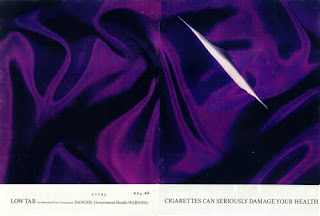
Image
This multiple award-winning advertisement from the 1980s indicates that it's promoting Silk Cut cigarettes solely by use of packaging colours and the visual metaphor of slashed material. It left the reader/viewer to work out the rest and thereby engaged them with a form of extrinsic gamification at a time before any marketers had heard that word. That's quite a contrast with yesterday's unsubtle approach that scans as poorly as the ubiquitous obtrusive QR codes which are flavour of the month right now. You can have engagement or you can have a shotgun wedding - we all know which is most likely to develop into a lengthy, meaningful relationship.

Make Marketing More Subtle.

Image
Ah the festive season. Family fun and a sense of bonhomie. Not in the hands of the marketers behind Ann Summers - UK high-street purveyors of "lingerie" and adult toys. "It's the dirty thoughts that count." Isn't Christmas the time for giving? So why not give your customers the opportunity to join the dots and engage with you a little rather than shoe-horning that dirty in there? It avoids the risk of appearing cheap and having a low opinion of your customers' literacy and, after all, don't they say subtle is sexier?

Customer Service as a Competitive Advantage

I’ve just returned from the National Arts Marketing Project Conference , the annual gathering of arts marketers convened by Americans for the Arts . I’ve gone to the conference for the past seven years to reconnect with colleagues, learn from case studies and catch up on new trends. As I return home this year, I am mindful that some arts marketers have limited control or influence over mission critical decisions, many of which affect audiences, revenue streams and branding. As marketers position themselves as growing agents of influence in their various organizations, I can’t help but think that perhaps our energies should be spent concentrating on the underperforming areas in which we can be the most impactful. In this new environment of reduced resources, the ability for an organization to identify its competitive advantages is vital. Some of which, marketers have no responsibilities for. Others, we lead. In listening to Scott Stratten's opening keynote address at the conference...

Proving Your Claim Is The Best Marketing.

Show and tell. In an interesting way. It's that simple.

Rebranding the Traditional Box Office

In a previous post entitled Subscriptions Dead? Maybe Not, I discussed various strategies Arena Stage employed in order to significantly increase its subscriber base. One of the most important was systematically identifying the best subscriber leads in our database, and then developing and implementing strategies to increase the number of similar leads. Like many others, we traded lists with other performing arts organizations during the acquisition portion of our subscription campaign. However, in doing so, we experienced an incredibly high cost-of-sale for each new subscriber. Even when factoring in the value of each new subscriber over multiple years, returns from mailings to traded lists didn't justify the cost. Our strategy was flawed, and it was time for a change. Data showed that our best leads were in our own database, with the best of the best being single ticket buyers who purchased tickets to multiple productions during the previous fiscal year. Instead of trying to attr...

Says Who?

Image
Having met Nicky Kinnaird many years ago, I know her to be a very smart woman building a terrific business founded on deep personal beliefs and thus I'm willing to accept the statement as true. But I was a bit bemused to see this in the window of a Space NK store. Does the attribution make it more credible? The stores are the physical incarnation of her philosophy - so those who know what NK stands for will not need to be convinced while others will wonder who Nicky Kinnaird is. It seems to me to be a form of celebrity endorsement in the eyes of her marketers, but does it weaken the advice? After all, she's not Japanese. Wouldn't modest anonymity be more in line with the slow organic growth of the business? Or does it just jar with me because I'm someone who knows the story rather than a potential customer?

Occasional Partial Attention.

Image
Last year, lots of people seemed to be blown away by the whole concept of the second screen. At this year's event , there were inaccurate murmurings that nothing new had been said. Such is the nature of media industry audiences - always looking for the radical when they should be dealing with the every day. But 2 screen is nothing new. We rarely, if ever, focussed entirely on the TV or anything else. The new thing is that the second screen is, in fact, a screen. In the past, we all experienced multiple input sources, but the second screen back then was radio, music or print. Media folk are excited that the second screen experience has interactive potential, but if they listened to Starling TV's CEO they'd have noted that the 90-9-1 rule abides. 90% of second screen "viewers" are viewing that second screen passively and, I would contend, casually. Nothing's really changed. Attention has always been partial and occasional - the question that marketers have to an...